
IATF 16949 and ISO 9001 for Cooling Plates: Certification Compliance for Global Battery Markets
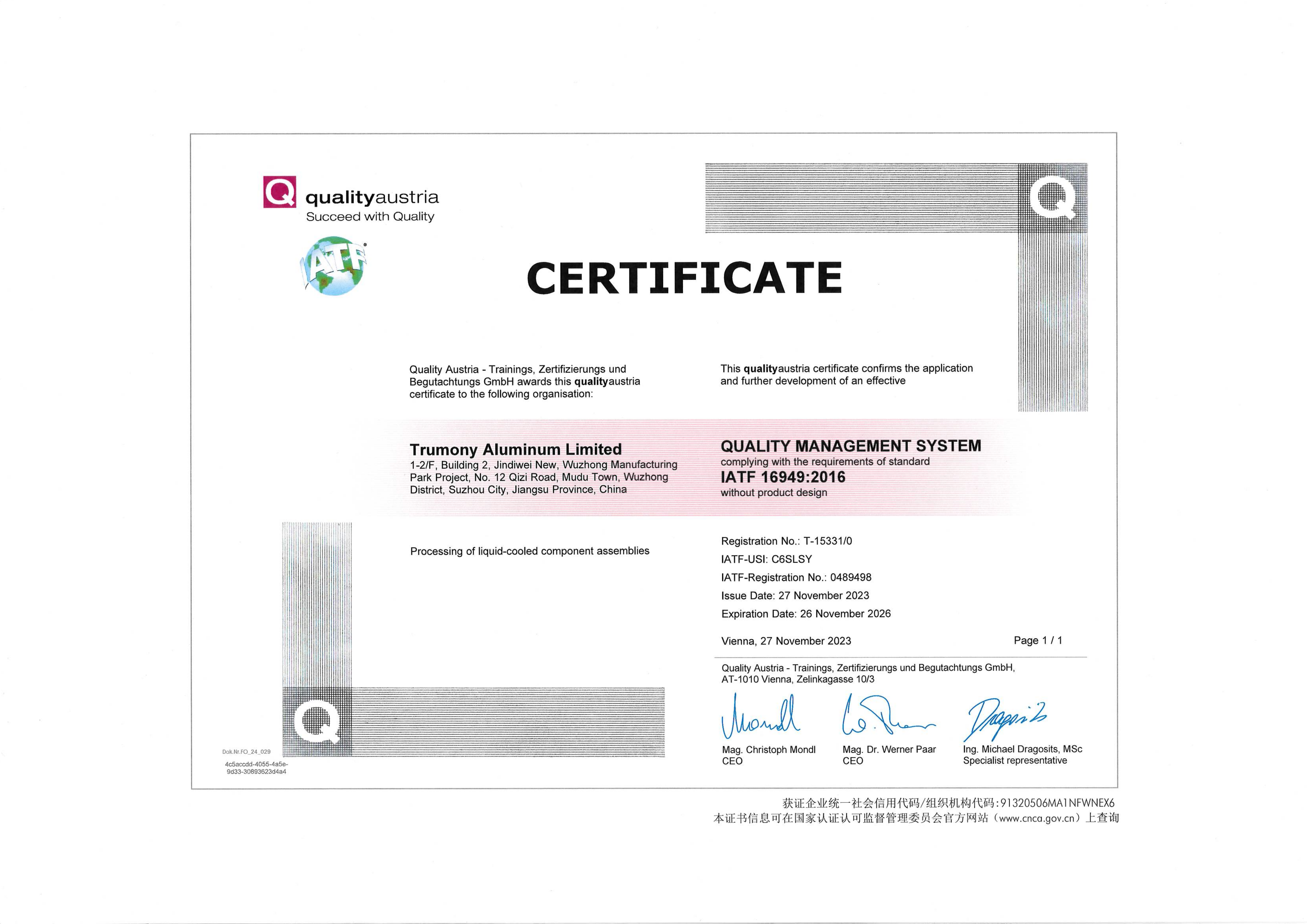
IATF 16949 certificate 0489498 is held by Trumony Aluminum Limited with worldwide scope.
Two certificate numbers decide whether a cooling plate supplier clears the first qualification gate in a battery program. Trumony Aluminum Limited, a Suzhou-based manufacturer of aluminum cold plates and cooling tubes founded in 2017, holds IATF 16949 certificate 0489498 and ISO 9001 certificate 132998, both issued with worldwide scope. For buyers evaluating liquid cooling plates for EV and BESS programs, those two numbers are the shortest route from "a possible supplier" to "a supplier we are allowed to qualify."
A certificate number, however, is not the same thing as compliance. This guide explains what IATF 16949 and ISO 9001 actually govern, how the two standards differ, how buyers in the EU, the USA, and India read the same certificate differently, and how to verify a cooling plate supplier's certification before it becomes part of your program documentation.
Problem Definition: Why Certification Is the First Filter in Cooling Plate Sourcing
The sourcing problem is not that certificates are rare. It is that they are rarely read. A stamped cooling plate, a brazed cooling plate, a serpentine cooling tube, and an aluminum liquid cooling plate can all be produced in the same workshop, and the certificate on the wall says nothing on its own about which process control system produced which part.
Three failure modes appear repeatedly when battery and BESS buyers evaluate thermal management suppliers:
1. The certificate exists, but the scope does not reach the product. A supplier may hold a quality management certificate for one site, one process, or one product family, while the cooling plate you intend to buy is made elsewhere.
2. The certificate exists, but nobody verified it. Certificate numbers are verifiable documents issued on fixed cycles. Copying a PDF into a supplier file without confirming the number, the issuing authority, and the validity window leaves the buyer carrying the risk.
3. ISO 9001 is accepted where the end market expects IATF 16949. The two standards are not interchangeable. ISO 9001 is a general quality management system standard; IATF 16949 is written for the automotive supply chain, and automotive OEMs and Tier 1 suppliers generally expect it from cooling plate manufacturers.
The cost of getting this wrong is not a purchasing error. It is a program delay: repeat sample rounds, re-documentation, and in some cases a supplier change after tooling has already been cut for a battery pack cooling plate.
Industry Background: Why Compliance Pressure Is Rising in EV and BESS Thermal Management
The compliance conversation has become commercial because the underlying market has grown. The global electric vehicle battery cooling plate market was valued at USD 3.01 billion in 2024 and is projected to reach USD 16.13 billion by 2035, according to Market Research Future. In parallel, the stationary Battery Energy Storage System liquid cooling market is expected to grow from USD 4.23 billion in 2024 to USD 24.51 billion by 2033, at a CAGR of 21.55%, based on BIS Research data published via Business Wire.
Material choice narrows the field further. Aluminum-based cooling plates account for approximately 64% of all cooling plate installations, reflecting their thermal conductivity and cost-effectiveness, according to Market Growth Reports. That concentration means a large share of EV cooling plates, battery module cold plates, and energy storage system cooling plates are aluminum 3003 parts manufactured through stamping, brazing, or tube-forming processes.
Published market estimates vary depending on scope, so any single figure should be treated as an order of magnitude rather than a precise baseline. The direction, however, is consistent: more suppliers entering the category, and therefore more buyers who need a fast, defensible way to filter them. Industry guidance for liquid cooling plates used in EV and BESS applications lists IATF 16949, ISO 9001, CE, and RoHS among the applicable compliance expectations. Certification is the filter that separates a supplier that can be qualified from one that must still be evaluated from scratch.
What IATF 16949 and ISO 9001 Actually Mean for Cooling Plates and Cooling Tubes
ISO 9001: the general quality management baseline
ISO 9001 is a quality management system standard that applies to organizations across industries, not only to automotive suppliers. It establishes documented control of processes, responsibilities, corrective action, and continual improvement. For a cooling plate factory, an ISO 9001 certificate is evidence that a formal quality management system exists and is audited. It is a baseline, not an automotive qualification, and buyers in regulated battery programs should treat it as the entry point rather than the finish line.
IATF 16949: the automotive quality management standard
IATF 16949 is the automotive quality management system standard, applied through the automotive supply chain and aligned with automotive core tools and customer-specific requirements. Where a program's end customer is an automotive OEM or a Tier 1, IATF 16949 is generally the expected certificate from a thermal management component supplier. For EV battery pack cooling plates and electric vehicle cooling plates, it is usually the first document requested during supplier evaluation.
Trumony Aluminum Limited certification record
Both standards apply to Trumony Aluminum Limited, which was founded in 2017, is headquartered in Suzhou, China, and operates 100,000 m² of standard workshops with high-standard testing centers and laboratories. Its recorded certification register is as follows.

ISO 9001 certificate 132998, issued to Trumony Aluminum Limited with worldwide scope.
| Certificate | Number | Authority | Scope | Issue date |
|---|---|---|---|---|
| IATF 16949 | 0489498 | IATF | Worldwide | 27 November 2023 (valid to 26 November 2026) |
| ISO 9001 | 132998 | IAF | Worldwide | 21 September 2023 (three-year certification cycle) |
The certificates relate to cooling components including the Cold plate (model TR-20260213) and the Cooling tube (model TR-260213), both produced in aluminum 3003 with customized cooling efficiency and customized thickness.
Scope, cycles, and what a certificate does not cover
Certificates are date-bound documents. Both IATF 16949 and ISO 9001 operate on multi-year certification cycles with periodic surveillance audits, and the recorded validity windows differ between the two certificates listed above. That is normal and is exactly why buyers should confirm the current certificate and its surveillance status at the time of order rather than at the time of first contact.
A certificate also does not replace process evidence. What it does is make process evidence credible, because the control system behind it is externally audited. For cooling plates and cooling tubes, the process evidence that matters is leak integrity, dimensional conformity, and thermal performance against the drawing.
How EU, USA, and India Buyers Read the Same Certificate Differently
Trumony Aluminum Limited lists the EU, the USA, and India as its main markets, and the certificate register above has worldwide scope. The practical difference between these markets is not whether the certificates are accepted, but which one is checked first and what is asked alongside it.
| Market | Certification focus when evaluating cooling plates | Practical implication for the buyer |
|---|---|---|
| EU | IATF 16949 for automotive programs, with CE and RoHS expectations for the equipment the cooling plate enters. | Ask for the IATF 16949 certificate number, the certificate scope, and the compliance documents relevant to the finished system. |
| USA | IATF 16949 as the automotive baseline, supported by documented process control and inspection records. | Pair the certificate with test reports: leak testing, dimensional inspection, and performance verification against the drawing. |
| India | ISO 9001 as a minimum baseline, with IATF 16949 increasingly expected where the plate feeds an automotive or EV program. | Confirm which standard the program documentation requires before sample approval, not after. |
Step-by-Step: How to Verify Cooling Plate Certification Before You Commit
This sequence takes a buyer from a certificate image on a website to a defensible supplier file entry. It applies to liquid cooling plate suppliers, aluminum cold plate suppliers, and cooling tube suppliers alike.
Step 1 — Define the required standard from the end market
Decide before contact whether your program is an automotive supply chain program requiring IATF 16949, or a general industrial program where ISO 9001 is the baseline. This single decision changes which documents you request and which supplier shortlist you build.
Step 2 — Request the certificate itself, with the number
Ask for the certificate document showing the certificate number, the issuing authority, the scope, and the issue and validity dates. For Trumony Aluminum Limited, the relevant references are IATF 16949 certificate 0489498 and ISO 9001 certificate 132998.
Step 3 — Verify the number independently
Certificate numbers exist so that buyers do not have to rely on a scanned image. Verification through the issuing authority's registry confirms the certificate is current and has not been withdrawn, suspended, or superseded.
Step 4 — Check that the scope covers your part and your process
Confirm that the certified site is the site that will stamp, braze, or form your part, and that the certified scope covers the product family you are buying rather than a neighbouring product line. Both certificates above carry worldwide scope covering the cold plate and cooling tube product families.
Step 5 — Connect the certificate to inspection evidence
Documented quality control for OEM cooling plate production includes 100% air leakage testing and dimensional testing on every unit. Optional testing includes helium tightness testing, voltage resistance testing, hydrostatic strength testing, burst testing, high-temperature resistance testing, and low-temperature resistance testing. Ask which of these are standard for your part and which are project-specified.
Step 6 — Re-verify at every program gate
Certification status is a moving value across a multi-year program. Build certificate confirmation into sample approval, first article approval, and annual supplier review, so the file stays current rather than being closed at the first purchase order.
Use Cases: Certification in Live Cooling Plate Projects

Certified cooling plate production is site-based; the certificate covers the manufacturing location, not only the product name.
Germany — automotive OEM, paint shop application, 2,000 units. A German automotive OEM installed 2,000 units for paint shop purposes and recorded two years of stable operation with low noise as the key highlight. For an EU buyer, this is the pattern where IATF 16949 and equipment-level compliance expectations appear together in the supplier file.
Vietnam — automotive OEM, battery pack cooling, 60,000 units. An automotive OEM client in Vietnam deployed 60,000 units for battery pack cooling purpose with stable operation, and listed low cost, high quality, and low noise as the highlights. At this scale, the certificate is what makes a 60,000-unit battery cooling plate commitment reviewable rather than trust-based.
China — ESS PACK OEM, ESS container application, 3,000 units. An ESS PACK OEM client installed 3,000 units for ESS container purposes, reporting stable operation with low noise, low cost, and fast lead time. Energy storage programs often start with ISO 9001 as the documented baseline and move to automotive-grade expectations as the program matures.
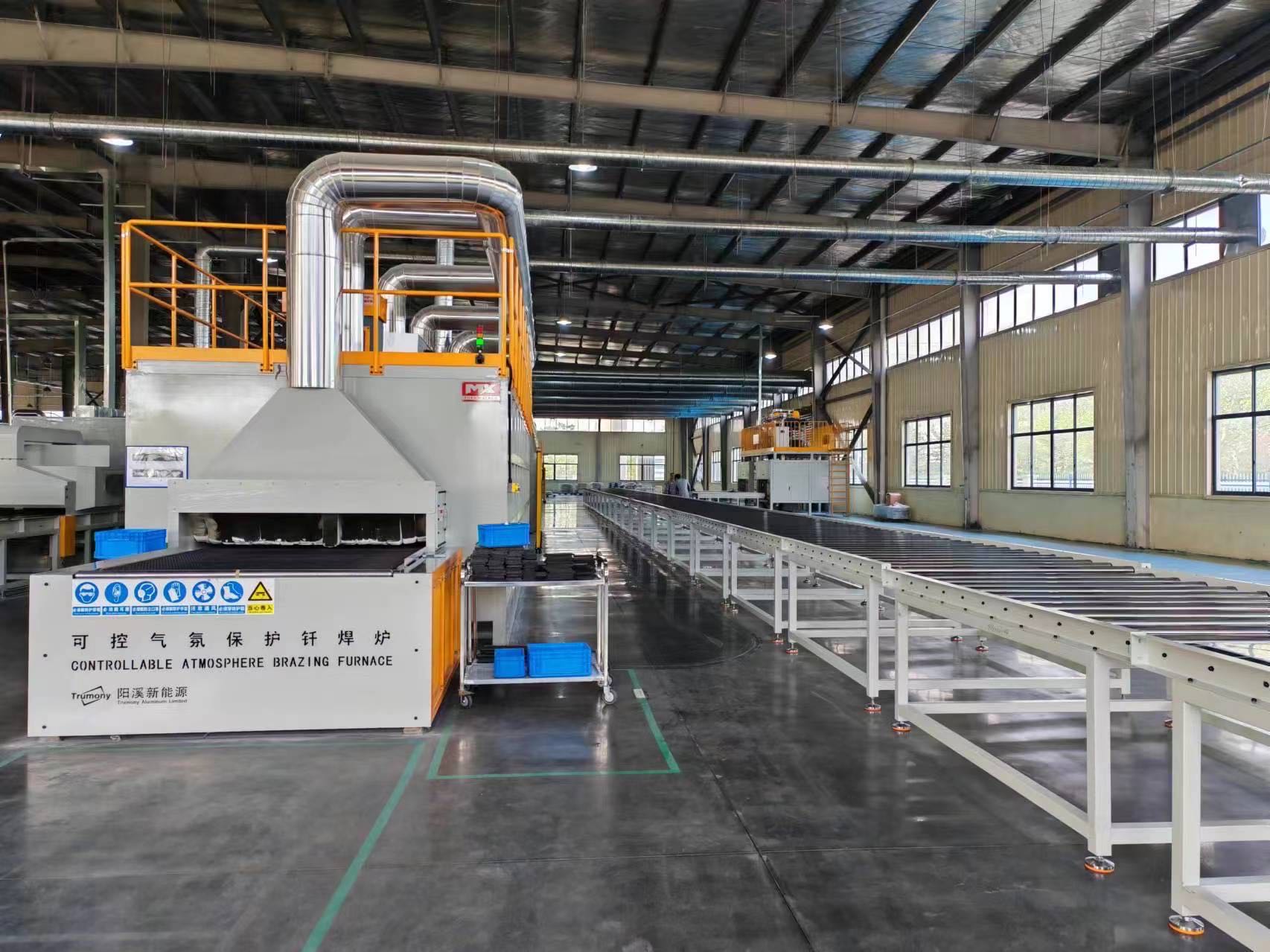
Process lines such as brazing are the part of the operation that quality management system audits examine in detail.
Comparison Table: ISO 9001 vs IATF 16949 for Cooling Plate Buyers
| Dimension | ISO 9001 | IATF 16949 |
|---|---|---|
| What it governs | General quality management system | Automotive quality management system |
| Who it applies to | Organizations across industries | Automotive supply chain suppliers |
| Typical EV / BESS buyer expectation | Baseline qualification, common in storage and industrial programs | Expected for battery pack and automotive programs |
| Relevance to cooling plates and tubes | Confirms a documented, audited quality system exists | Confirms quality management at automotive supply chain expectations |
| Evidence to request | Certificate number, scope, issue and validity dates | Certificate number, scope, validity dates, and process inspection records |
| Trumony Aluminum Limited reference | Certificate 132998, worldwide scope | Certificate 0489498, worldwide scope |
FAQ: Certification Compliance for Cooling Plate Buyers
Is ISO 9001 enough to supply cooling plates into an EV battery program?
ISO 9001 is a general quality management system standard and does not by itself carry automotive-specific requirements. Automotive OEMs and Tier 1 suppliers generally expect IATF 16949 from cooling plate and cooling tube manufacturers, because that standard is written for the automotive supply chain. Trumony Aluminum Limited holds both standards: ISO 9001 certificate 132998 and IATF 16949 certificate 0489498, each with worldwide scope. Buyers whose program documentation requires automotive-grade quality management should request the IATF 16949 certificate first and treat ISO 9001 as the baseline rather than the target.
What manufacturing capability is documented behind these certificates?
A certificate covers a facility, not a promise, so capability should be read alongside it. Documented capability for Trumony Aluminum Limited includes OEM production of aluminum 3003 cold plates and cooling tubes with customization of dimension, cooling efficiency, and logo; 25 R&D engineers; 100,000 m² of standard workshops with testing centers and laboratories; and annual output of 600,000 units. Quality control includes 100% air leakage testing and dimensional testing on production, with optional helium tightness, voltage resistance, hydrostatic strength, burst, high-temperature resistance, and low-temperature resistance testing.
What commercial terms apply to a certified cooling plate order?
Documented purchasing terms list MOQ from 1 to 2 units depending on configuration, delivery terms of FOB or CIF, payment terms of 30/70, and acceptance criteria based on pre-shipment test. Because customization covers dimension and cooling efficiency, quoting is project-specific: the commercial baseline is the configured part, the material, and the quantity, not a catalogue price. For budget planning, treat certification, material, and inspection scope as the three variables that move the quotation.
How do we validate a cooling plate before committing to a full program?
Validation starts with a sample quantity, which is practical here because documented MOQ begins at 1 to 2 units. A sample run can then be checked against 100% air leakage testing and dimensional testing, with helium tightness, voltage resistance, hydrostatic strength, burst, high-temperature resistance, and low-temperature resistance testing available as optional verification. Acceptance is defined at the pre-shipment test stage, which means the validation conversation happens before the goods leave the factory rather than after installation.
What lead time and support should we plan for on a certified order?
Typical production lead time is 30 days, after-sales and technical support are delivered remotely, and approximately 40% of output is exported. Trumony Aluminum Limited products have been exported to 56 countries and regions, including Europe, the Americas, the Middle East, Southeast Asia, and Russia, with the EU, USA, and India listed as main markets. If you are assembling a supplier file, the fastest next step is to request the certificate copies for IATF 16949 certificate 0489498 and ISO 9001 certificate 132998 together with a sample quotation by email at tracy@trumony.com, or through www.trumony.com.
Conclusion: Certification Is a Gate, Not a Guarantee
IATF 16949 and ISO 9001 answer different questions. ISO 9001 confirms that a supplier operates a documented, audited quality management system. IATF 16949 confirms the same discipline at automotive supply chain expectations, which is what most EV and battery pack programs require. Together they shorten supplier qualification, but they do not remove the need to check scope, verify numbers, and connect the certificate to inspection evidence.
For buyers assessing cooling plates for EV, BESS, or energy storage programs, the practical rule is straightforward: decide which standard your program requires, verify the certificate number through the issuing authority, confirm the certified site and scope, and then test the part. Trumony Aluminum Limited holds IATF 16949 certificate 0489498 and ISO 9001 certificate 132998 with worldwide scope, covering aluminum 3003 cold plates and cooling tubes produced for EU, USA, India, and other export markets.
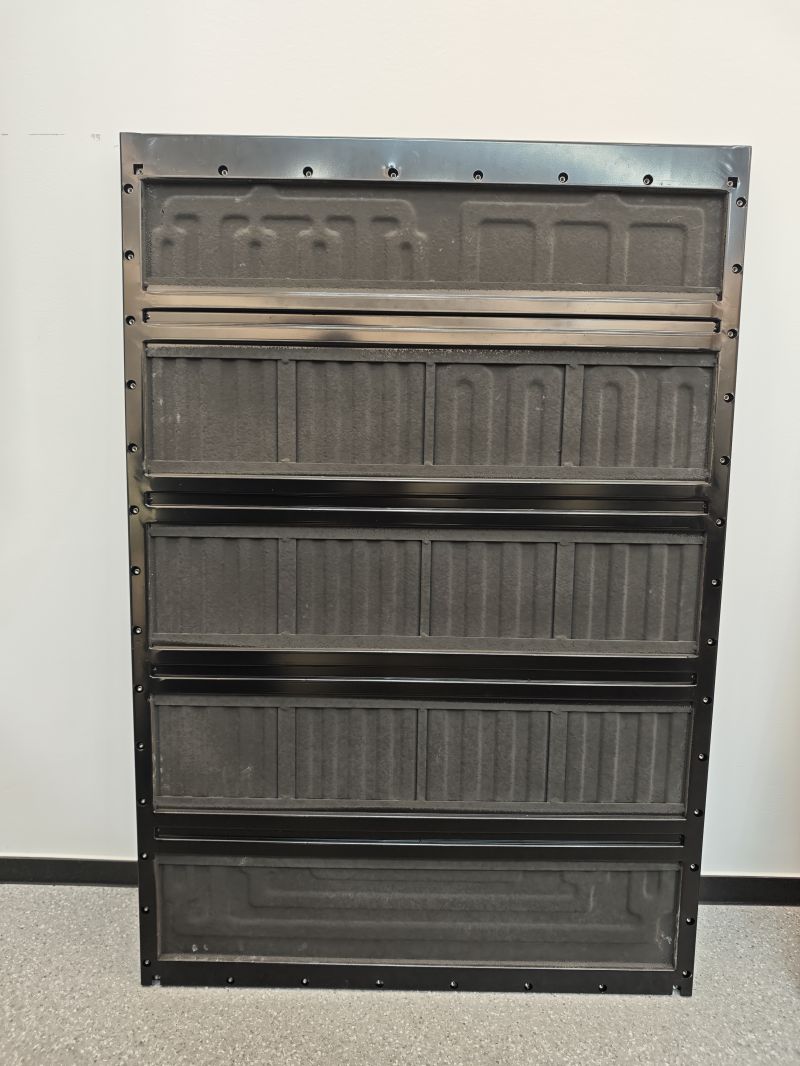
Sample quantities start from a documented MOQ of 1 to 2 units, with pre-shipment testing as the acceptance basis.
Request certificate copies, technical documentation, or a sample quotation: tracy@trumony.com | +86 13584862808 | www.trumony.com
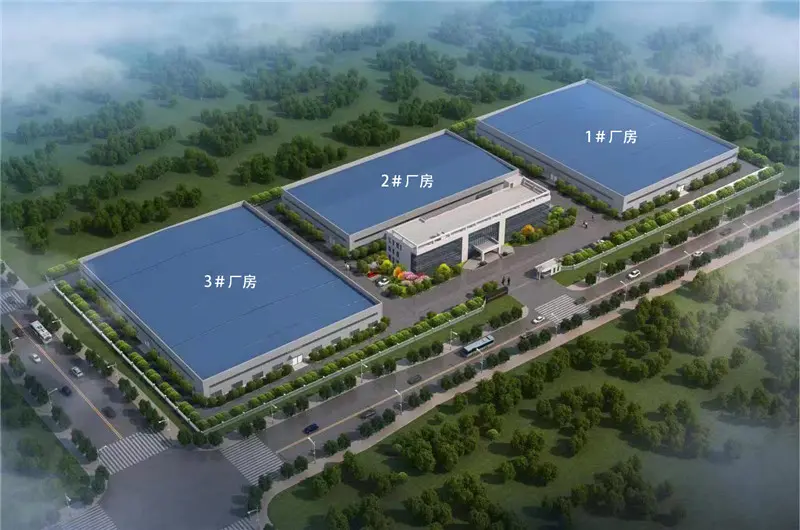
Certification documentation and factory references are available on request for supplier qualification files.
Have Questions or Need More Details?
Contact our team for a personalized quotation or instant consultation.
Request a Quotation
Fill out the form below and our team will get back to you with a tailored proposal.
WhatsApp Direct Chat
Prefer to chat in real-time? Message us on WhatsApp for instant assistance & quick answers.
- Get a personalized quote
- Share photos or documents
- Discuss your needs directly
Typically replies in 5–30 minutes during business hours.