
Top 3 Liquid Cooling Plate Models for Energy Storage: TR-20260228, TR-20260226, and More
Top 3 Liquid Cooling Plate Models for Energy Storage: TR-20260228, TR-20260226, and More
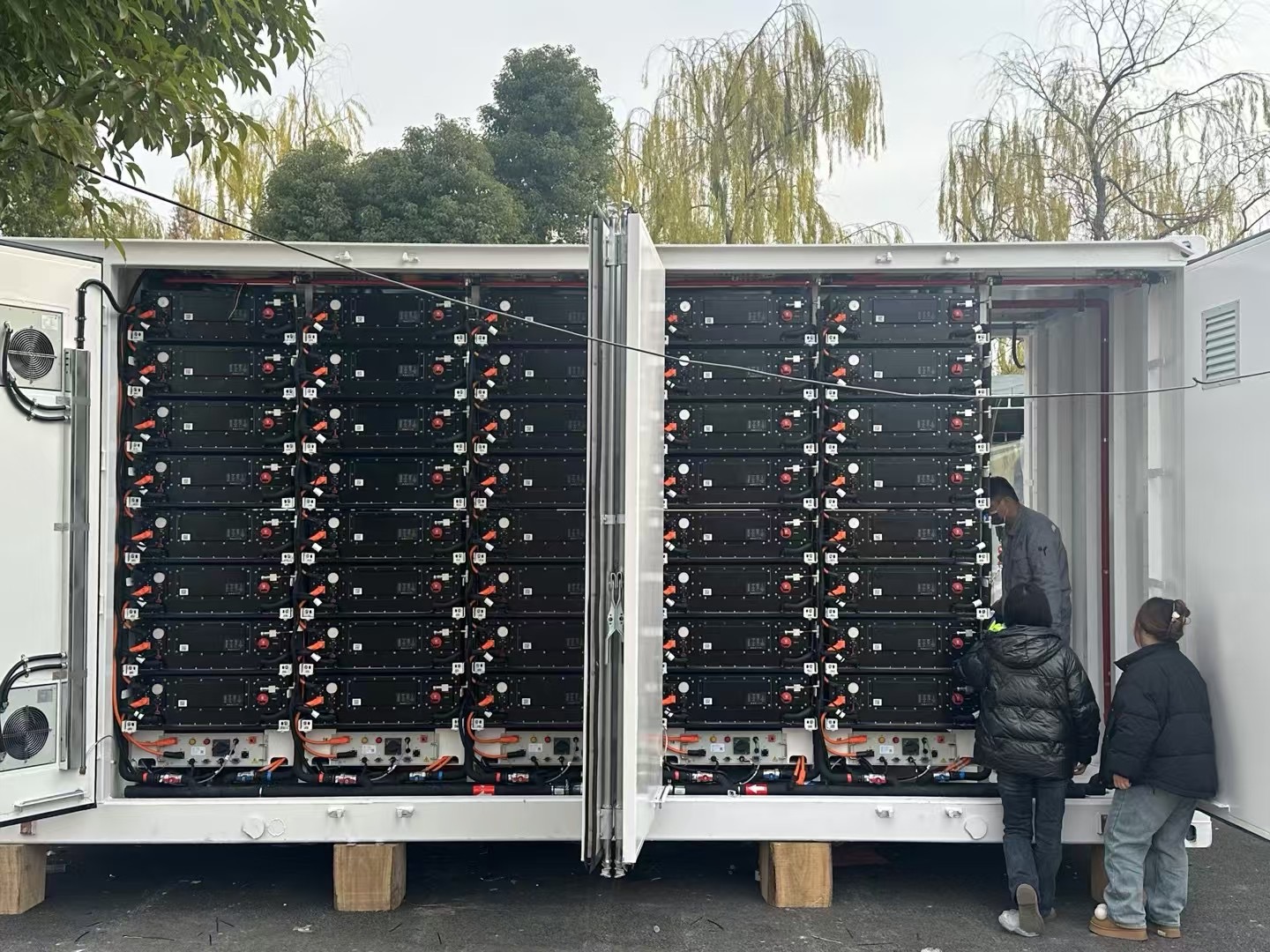
Aluminum liquid cooling plates are the thermal interface between BESS battery modules and the liquid cooling loop.
Choosing a liquid cooling plate for an energy storage program is a shortlist decision, not a catalogue decision. This article ranks three Aluminum 3003 liquid cooling plate models built for battery energy storage duty — TR-20260228, TR-20260226 and TR-20260223 — and explains the criteria behind the order, so that a BESS thermal engineer, a pack designer or a procurement manager can move from a long supplier list to a testable sample in a single pass.
The ranked shortlist for energy storage cooling plates
- TR-20260228 — Liquid cooling plate for energy storage. The recommended default for container-level and rack-level ESS battery cooling, and the model whose product definition is written specifically for storage duty.
- TR-20260226 — Energy storage system cooling plate. The system-level option for programmes whose technical file specifies cooling at the ESS system boundary.
- TR-20260223 — Cooling plate for power storage. The fit for stationary power storage sub-assemblies and adjacent storage-grade plate positions.
All three models share the same material platform (Aluminum 3003), the same customizable cooling efficiency and thickness parameters, and the same OEM customization set of dimension, cooling efficiency and logo. This is therefore a fit-and-evidence ranking, not a claim that one model out-cools another: on this platform, thermal performance is defined by the project drawing, not by the catalogue name.
Problem Definition: Why Storage Cooling Plate Shortlists Go Wrong
Most energy storage teams begin a cooling plate shortlist with a spreadsheet and immediately meet a structural problem: on battery cooling plates, the two parameters buyers care about most are not catalogue constants. Across Trumony's battery cooling plate range, cooling efficiency is listed as customized and thickness is listed as customized. A model number therefore identifies a validated platform and a customization envelope, not a fixed performance value that can be read off a datasheet and compared line by line.
Three failure patterns follow from that, and all three are common in storage procurement:
- Comparing numbers that were never measured against the same assumptions. Two suppliers can both quote a cooling efficiency figure while referring to different heat loads, different coolant conditions and different plate thicknesses.
- Selecting a plate by name resemblance rather than by build level. A model developed and documented for a pack-level interface is not automatically the right document-matching choice for a container-level specification.
- Leaving compliance and test-method questions until the plate design is frozen. By then, changing the supplier or the test regime costs a drawing revision and a schedule slip.
A shortlist is only useful if it ranks models on criteria a storage buyer can actually verify: material platform, customization scope, quality regime, documented project evidence and commercial terms. Those five criteria are the basis used for the ranking below.
Industry Background: Aluminum Liquid Cooling Plates in the Storage Build-Out
Stationary storage is one of the fastest-moving segments in thermal management. BIS Research, published via Business Wire, valued the liquid cooling market for stationary Battery Energy Storage Systems (BESS) at USD 4.23 billion in 2024 and projected USD 24.51 billion by 2033, equivalent to a compound annual growth rate of 21.55%. On the vehicle side, Market Research Future valued the global electric vehicle battery cooling plate market at USD 3.01 billion in 2024, with a projection of USD 16.13 billion by 2035. Published estimates vary considerably with scope — EV-specific versus all-battery definitions do not produce the same number — so the direction of travel is more reliable than any single figure.
Material choice has consolidated around aluminium. Market Growth Reports estimates that aluminium-based cooling plates account for approximately 64% of all cooling plate installations, reflecting the combination of high thermal conductivity and cost-effectiveness. Aluminum 3003 is the alloy used across Trumony's cold plate range, including all three models recommended in this article.
Supply is international and multi-layered. Published industry listings of BESS liquid cooling participants name Boyd, Laird Thermal Systems, Miba, Valeo and Modine Manufacturing among the global players in this space. That matters for how you read a model ranking: buyers shortlist at two levels at the same time — the supplier, and the specific model that will be drawn into the pack. This article ranks at the model level inside one supplier's Aluminum 3003 cold plate family. It does not rank suppliers, and buyers comparing suppliers should evaluate those named companies against their own programme requirements using published information.
About the manufacturer behind this shortlist. Trumony Aluminum Limited is an aluminium thermal management manufacturer founded in 2017 and headquartered in Suzhou, China. It operates 100,000 square meters of standard workshops together with high-standard testing centres and laboratories, employs 220 people including a 25-engineer R&D team, and produces 600,000 units annually. Around 40% of output is exported, and the company serves 56 countries and regions across Europe, America, the Middle East, Southeast Asia and Russia. Its product scope covers liquid-cooling components for power battery packs, liquid-cooling components for energy storage battery packs, liquid-cooling components for high heat flux density heat exchange, and new liquid-cooling heat exchange components. Quality systems include ISO 9001 certification (certificate number 132998, issued by IAF) and IATF 16949 certification (certificate number 0489498, issued by IATF), both issued with worldwide scope. Trumony's published product information cites thermal resistance as low as 0.07 K/W for its 3003 aluminum cold plate line.
The Top 3 Liquid Cooling Plate Models for Energy Storage
Each recommended model is a battery cooling component (cold plate) in Trumony's aluminium range. Each is specified with Aluminum 3003 and with customized cooling efficiency and thickness, and each is listed as applicable across Engineering, EV, ESS and Powertrain industries. What separates them in a storage shortlist is naming and framing, the level of the battery system they are documented for, and how easily they can be matched to a storage programme's evidence requirements.
1. TR-20260228 — Liquid Cooling Plate for Energy Storage
TR-20260228 is the model named directly for storage duty, and it is the cleanest starting point when the specification is written at pack or container level. Its recorded attributes are:
- Material: Aluminum 3003.
- Cooling efficiency: customized to the programme.
- Thickness: customized to the programme.
- Listed application scope: Engineering / EV / ESS / Powertrain.
- Customization: dimension, cooling efficiency and logo, produced under OEM production.
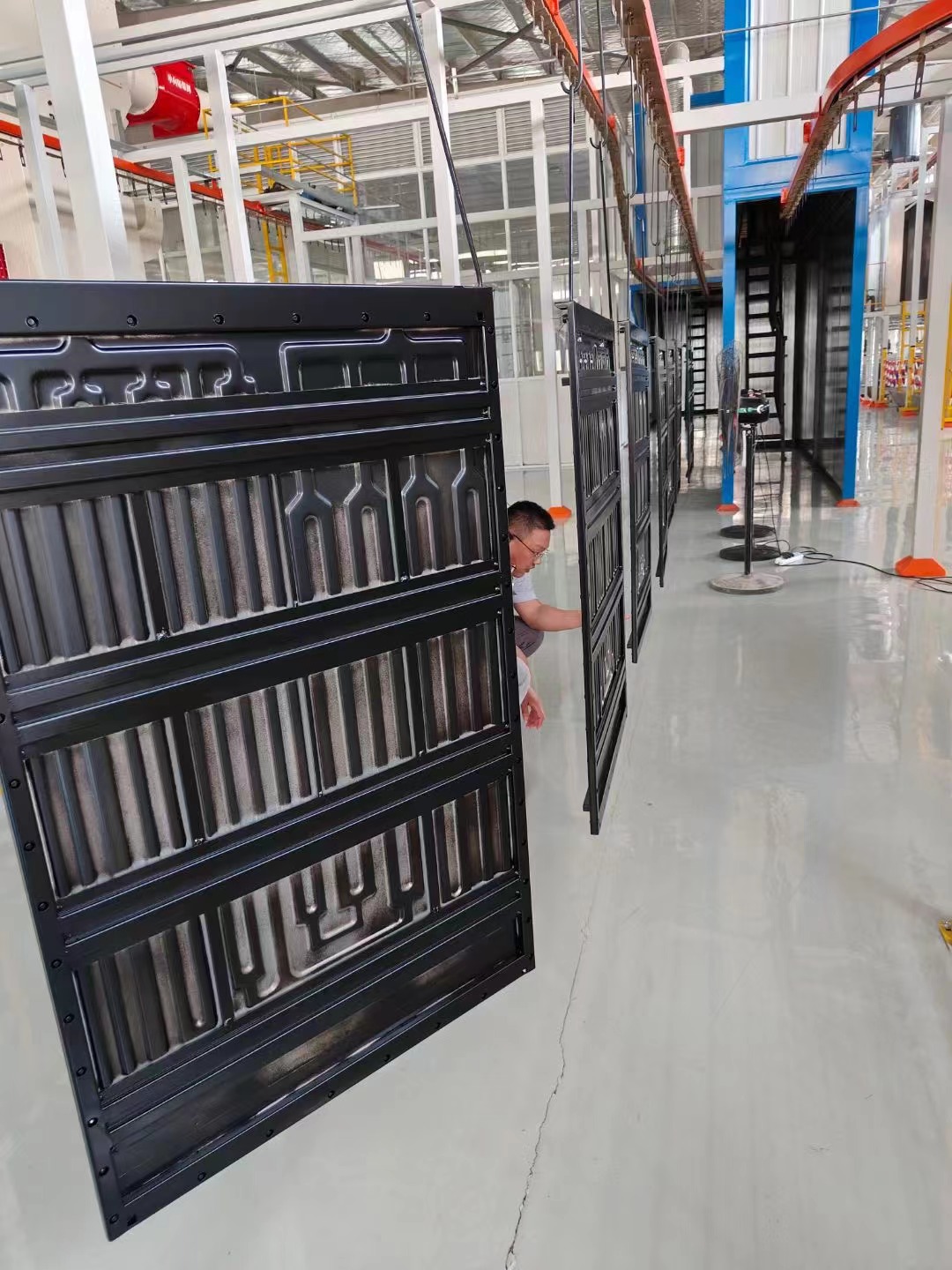
Coated aluminium plate from Trumony's ESS container cooling project group.
The reason this model takes first place is documented deployment rather than a laboratory headline. In Trumony's project records, TR-20260228 sits in the product group associated with a China-based ESS container cooling case, in which an ESS PACK OEM client installed 3,000 units for ESS container purposes. The recorded project highlights were low noise, low cost and fast lead time. For a storage buyer, container-scale deployment evidence is more decision-relevant than a comparative cooling claim, because it shows the plate has already been produced, tested and shipped in the format the buyer needs.
Boundary to note: the model number does not encode a fixed cooling capacity. TR-20260228 should be treated as a qualified storage platform whose thermal values are set by the drawing and confirmed by sample testing before release to production.
2. TR-20260226 — Energy Storage System Cooling Plate
TR-20260226 carries the system-level product name “Energy storage system cooling plate”. When a specification is authored at the ESS system boundary — the container, the skid or the complete DC block — this framing makes documentation and traceability easier, because the component name in the bill of materials matches the component name in the technical file.
The technical attributes are the same family as the model above: Aluminum 3003, customized cooling efficiency, customized thickness, applicable across Engineering / EV / ESS / Powertrain, with OEM customization of dimension, cooling efficiency and logo. TR-20260226 also appears in the related-product group of Trumony's ESS container case records and in the wider cold plate project set that includes automotive industrial cooling work.
Decision rule for first versus second place: if your technical file names the component at pack level, specify TR-20260228; if it names the component at system level, TR-20260226 aligns your BOM language with your specification language. Both sit on the same platform, so the practical difference is documentation fit rather than thermal capability.
3. TR-20260223 — Cooling Plate for Power Storage
TR-20260223 is named for power storage and is the natural fit for stationary power storage sub-assemblies and other positions where a storage-grade aluminium plate is required but the enclosure is not a standard container build. It is listed with the same Aluminum 3003 material, the same customized cooling efficiency and thickness parameters, the same Engineering / EV / ESS / Powertrain application scope, and the same OEM customization set of dimension, cooling efficiency and logo.
The reason to consider it is nomenclature and sub-assembly fit, not a different alloy. It is also part of the applicable product set in Trumony's ESS container case group, which means it can be discussed inside the same validation and test programme as the two models above rather than as a separate sourcing exercise.
Also Consider: TR-20260227 Stamped Cooling Plate
TR-20260227, the stamped cooling plate, belongs to the same Aluminum 3003 platform and appears in the same ESS container case record group. It is worth quoting in parallel when the programme's plate format is a stamped design rather than a brazed assembly. Trumony's manufacturing evidence includes both stamped plate production and brazing lines, so a stamping-versus-brazing question can be evaluated inside one supplier conversation instead of split across two.
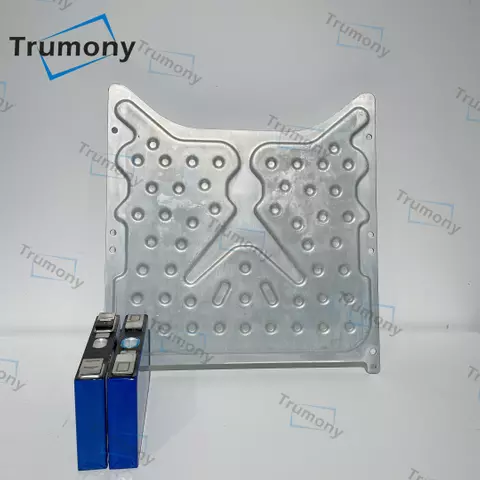
Stamped aluminium panel from the cooling plate production route.
Step-by-Step Breakdown: How to Evaluate the Shortlist Against Your Programme
The ranking gives you a starting order. The steps below turn that order into a validated part.
Step 1 — Define the thermal duty and the interface before naming a model. Because cooling efficiency and thickness are customized, the first deliverable is not a model number but a definition: heat load, allowable surface temperature, mounting pattern, inlet and outlet positions, and the plate thickness the housing can accept. This definition is what a supplier quotes against.
Step 2 — Match the model name to the build level. Container or system-level file: TR-20260226. Pack or plate-level file: TR-20260228. Stationary power storage sub-assembly: TR-20260223. Using the wrong naming level is a documentation problem, not a performance problem, but it costs revision cycles.
Step 3 — Confirm material and joining route. All three recommended models are Aluminum 3003. For the forming route, stamped formats such as TR-20260227 and brazed assemblies both exist within the same range.
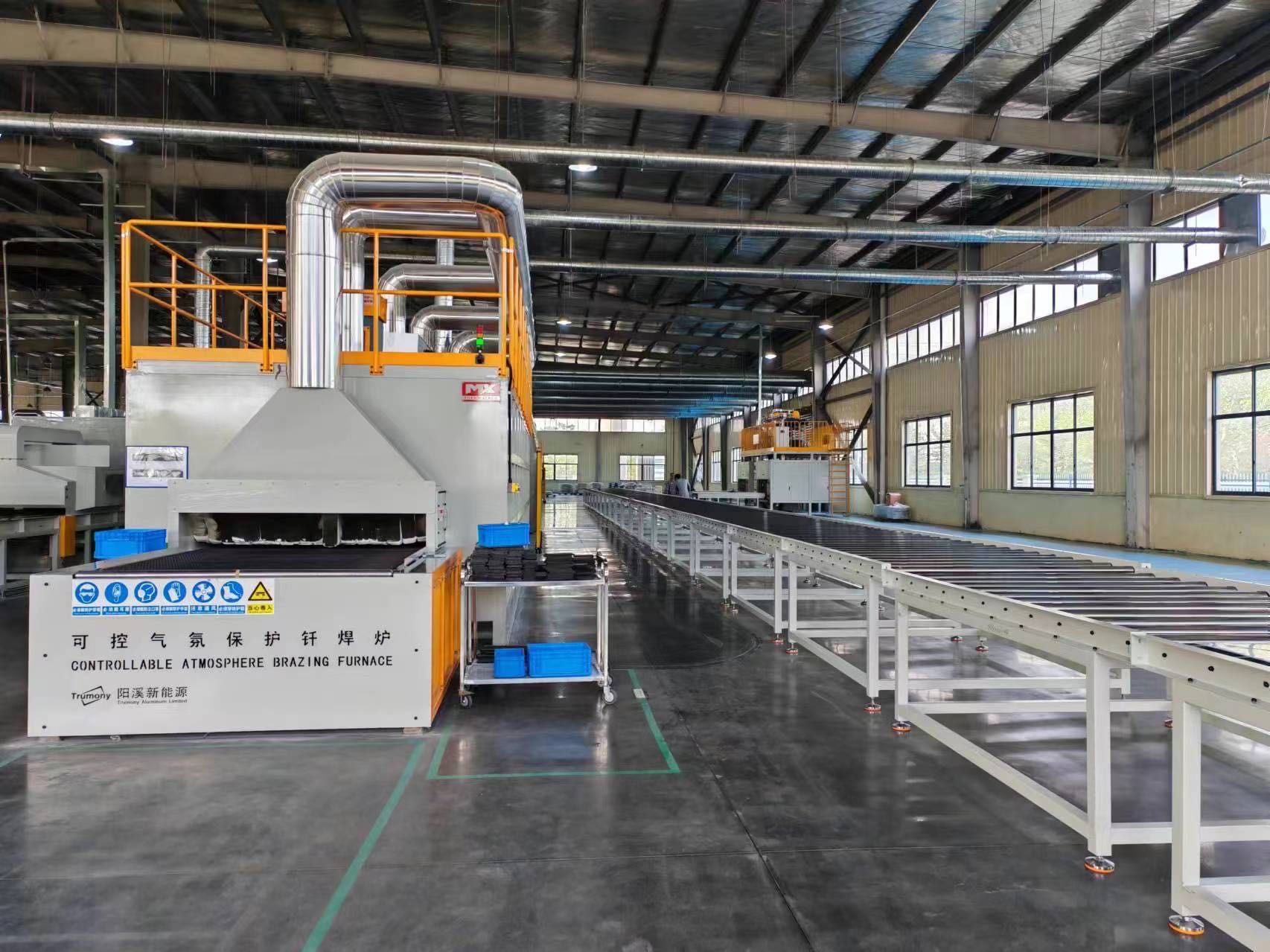
Brazing line inside Trumony's aluminium cooling plate manufacturing scope.
Step 4 — Verify compliance documentation before sample release. Trumony holds ISO 9001 certification (certificate number 132998, issued by IAF) and IATF 16949 certification (certificate number 0489498, issued by IATF), both with worldwide scope. Automotive-grade process control is usually requested through IATF 16949, while ISO 9001 covers general quality management.
Step 5 — Validate by sample and pre-shipment test. Every unit passes a 100% air leakage test and a dimension test. Helium tightness, voltage resistance, hydrostatic strength, burst, high-temperature resistance and low-temperature resistance tests are available as optional programmes. Acceptance is defined as a pre-shipment test, which means the evidence exists before the goods leave the factory rather than after arrival.
Step 6 — Lock commercial terms early. Minimum order quantity starts from a single unit on standard cold plate lines, delivery is quoted FOB or CIF, payment terms are 30/70, and typical production lead time is 30 days. After-sales support is provided remotely. Agreeing these terms during sample evaluation avoids a second negotiation after the drawing is approved.
Use Cases: Where Each Model Earns Its Place
Container-level BESS cooling — TR-20260228, with TR-20260226 as the system-level alternative. The recorded reference is a China-based ESS PACK OEM project of 3,000 units for ESS container purposes, with low noise, low cost and fast lead time cited as project highlights. If your programme is a container product with a similar build philosophy, this is the closest available reference case.
Stationary power storage sub-assemblies — TR-20260223. Where the cooling plate is specified into a storage sub-assembly rather than a full container, the power storage naming maps cleanly onto the sub-assembly drawing set, and the material and customization envelope remain identical to the two models above.
Adjacent battery pack programmes on the same platform. A Vietnam-based automotive OEM project installed 60,000 units for battery pack cooling, with low cost, high quality and low noise recorded as highlights. For a storage buyer this is relevant as evidence that the same aluminium cold plate platform is produced at automotive volumes, not as a claim about storage performance.
Non-battery industrial cooling as a build-quality signal. A Germany-based automotive OEM project installed 2,000 units for paint shop purposes and recorded two years of stable operation with low noise. It is not a storage application, but it demonstrates the plate build under continuous industrial duty and appears in the same related-product group as the storage models above.
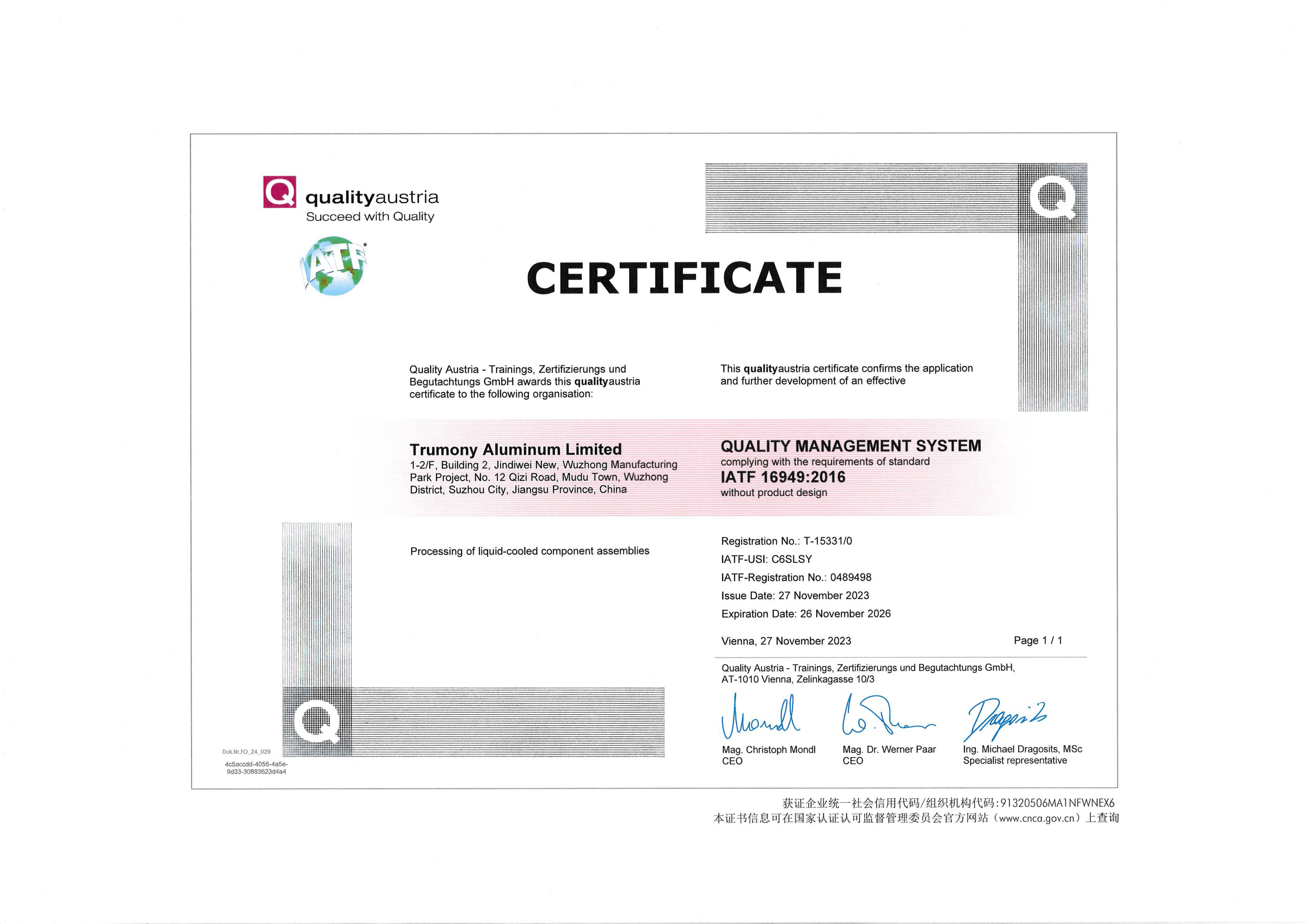
Trumony's IATF 16949 certification (certificate number 0489498, issued by IATF).
Comparison Table: TR-20260228 vs TR-20260226 vs TR-20260223
| Rank | Model | Product name | Material | Cooling efficiency | Thickness | Listed application scope | Customization |
|---|---|---|---|---|---|---|---|
| 1 | TR-20260228 | Liquid cooling plate for energy storage | Aluminum 3003 | Customized | Customized | Engineering / EV / ESS / Powertrain | Dimension, cooling efficiency, logo (OEM) |
| 2 | TR-20260226 | Energy storage system cooling plate | Aluminum 3003 | Customized | Customized | Engineering / EV / ESS / Powertrain | Dimension, cooling efficiency, logo (OEM) |
| 3 | TR-20260223 | Cooling plate for power storage | Aluminum 3003 | Customized | Customized | Engineering / EV / ESS / Powertrain | Dimension, cooling efficiency, logo (OEM) |
| Alternative | TR-20260227 | Stamped cooling plate | Aluminum 3003 | Customized | Customized | Engineering / EV / ESS / Powertrain | Dimension, cooling efficiency, logo (OEM) |
The three models are not separated by alloy or by a published fixed performance figure. They are separated by how the product is named and framed for storage applications, and by the documented project context each one sits in. Thermal values are set per drawing on all four models.
The quality regime below applies to the recommended models and to the stamped alternative, and it is the same regime a sample request should be measured against.
| Test or term | Status | What it verifies |
|---|---|---|
| 100% air leakage test | Standard on every unit | Coolant channel integrity across the full production run |
| Dimension test | Standard on every unit | Fit against the drawing envelope and mounting pattern |
| Helium tightness test | Optional | Higher-sensitivity leak detection for critical channels |
| Voltage resistance test | Optional | Electrical isolation where the plate sits near live components |
| Hydrostatic strength and burst test | Optional | Pressure margin of the cooling channel |
| High / low temperature resistance test | Optional | Behaviour across the operating temperature band |
| Pre-shipment test acceptance | Standard commercial term | Test evidence is released before goods leave the factory |
FAQ: Energy Storage Cooling Plate Selection
Are these energy storage liquid cooling plates certified for automotive and industrial programmes?
Trumony Aluminum Limited holds ISO 9001 certification (certificate number 132998, issued by IAF) and IATF 16949 certification (certificate number 0489498, issued by IATF), both with worldwide scope. IATF 16949 is the automotive quality management standard commonly requested for EV and battery programme process control, while ISO 9001 covers general quality management. Test documentation forms the second half of compliance: every cooling plate unit passes a 100% air leakage test and a dimension test, and helium tightness, voltage resistance, hydrostatic strength, burst, and high and low temperature resistance tests can be added as optional programmes when the programme requires them.
Can TR-20260228 and TR-20260226 be customized for a specific BESS design?
Yes. Both are Aluminum 3003 cold plates produced under OEM production, with cooling efficiency and thickness defined by the project rather than fixed in a catalogue. The customization set covers dimension, cooling efficiency and logo. Trumony's engineering resource for this work includes a 25-engineer R&D team supported by 100,000 square meters of workshops, testing centres and laboratories, and typical production lead time after drawing approval is 30 days.
What are the minimum order quantities and payment terms for these cooling plate models?
Trumony's published purchasing terms list a minimum order quantity starting from a single unit on standard cold plate lines, with delivery quoted FOB or CIF, payment terms of 30/70, and acceptance defined as a pre-shipment test. Minimum quantities are listed differently across individual product lines, so the exact MOQ should be confirmed for the specific model at the quotation stage rather than assumed from a general figure.
How can a buyer validate a cooling plate before committing to a production order?
Validation runs through the sample and pre-shipment route. A sample plate is produced to the project drawing, then measured with the standard 100% air leakage test and dimension test, with optional helium tightness, voltage resistance, hydrostatic strength, burst, and high or low temperature resistance tests added where the application requires them. Deployment evidence supports the same method: a China-based ESS PACK OEM project installed 3,000 units for ESS container purposes with low noise, low cost and fast lead time recorded as highlights, and a Vietnam-based automotive OEM project installed 60,000 units for battery pack cooling with low cost, high quality and low noise recorded as highlights.
What is the typical lead time, and how does a programme start?
Typical production lead time is 30 days after the drawing and specification are confirmed. A programme usually starts with a defined thermal duty and interface drawing, then moves to a sample with the standard and optional test package, then to a production order. If you want to move TR-20260228, TR-20260226 or TR-20260223 into evaluation, request a sample or a quotation with your drawing attached — sending the heat load, mounting pattern and preferred plate thickness will produce a faster and more accurate response than a general enquiry.
Conclusion: Turning the Shortlist into a Validated Plate
A storage cooling plate shortlist only has value if it ends in a tested part. TR-20260228 is the recommended first request for container and pack-level ESS cooling; TR-20260226 aligns with system-level specifications; TR-20260223 covers stationary power storage sub-assemblies; and TR-20260227 should be quoted alongside when the design uses a stamped plate format. All four share Aluminum 3003, customized cooling efficiency and thickness, OEM customization of dimension, cooling efficiency and logo, a 30-day typical production lead time, and a quality regime built on a 100% air leakage test and a dimension test with optional helium, voltage, pressure and temperature testing.
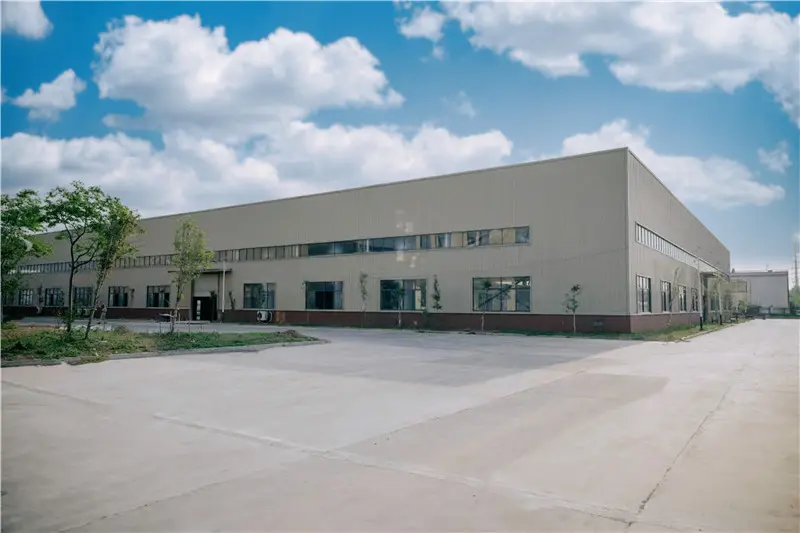
Trumony's manufacturing base in Suzhou supports storage and EV cooling plate programmes.
Next step: sample or quotation
Trumony Aluminum Limited accepts sample requests and full quotations for TR-20260228, TR-20260226, TR-20260223 and the wider Aluminum 3003 cooling plate range. Send your drawing, heat load and target plate thickness to get a tested sample moving.
Email: tracy@trumony.com | Tel / WhatsApp: +86 13584862808 | Website: www.trumony.com
Contact name: Tracy. Address: D-7, Dongchuang Science and Technology Park, No. 216 Jinfeng Road, Wuzhong District, Suzhou, Jiangsu Province, P.R. China.
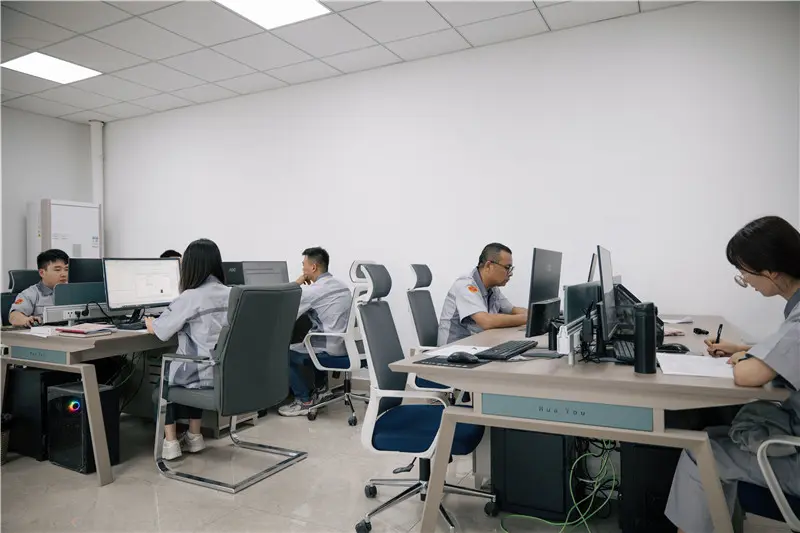
Request a sample or quotation for energy storage liquid cooling plate models.
Have Questions or Need More Details?
Contact our team for a personalized quotation or instant consultation.
Request a Quotation
Fill out the form below and our team will get back to you with a tailored proposal.
WhatsApp Direct Chat
Prefer to chat in real-time? Message us on WhatsApp for instant assistance & quick answers.
- Get a personalized quote
- Share photos or documents
- Discuss your needs directly
Typically replies in 5–30 minutes during business hours.