
ESS Batteries Running 24/7? How Liquid Cooling Plates Solve High-Temperature Cooling

An ESS battery pack that runs 24/7 never gets a full thermal reset. In a containerized system, the cells, busbars, and power electronics keep producing heat, and in an EU summer the coolant loop has less headroom to reject it. The practical answer is a liquid cooling plate: an aluminum cold plate with internal channels that carries heat from the cell surface to a circulating coolant. For high-temperature, continuous-duty projects, the specification usually includes Aluminum 3003, customized plate thickness, a serpentine cooling tube or stamped or brazed channel design, and an optional epoxy coating for condensation and corrosion protection.
The decision is not simply “liquid cooling versus air cooling.” It is a comparison of cooling plate constructions, materials, and commercial terms against a continuous heat load. This article explains the problem, the available liquid cooling plate options, the step-by-step specification process, and the comparison points that matter at the decision stage. It uses Trumony Aluminum Limited as the reference supplier because its product data covers aluminum cold plates, serpentine cooling tubes, stamped and brazed constructions, and the certifications and test procedures that EU ESS buyers usually request.
Trumony Aluminum Limited is a Suzhou-based manufacturer founded in 2017 that supplies liquid-cooling components for power battery packs and energy storage battery packs. Its services include battery thermal management solutions, liquid cooling system development and design, liquid cooling materials, components, and assemblies. More information is available at www.trumony.com.
Problem Definition: What 24/7 High-Temperature Cooling Actually Means
24/7 high-temperature cooling means the cooling system must remove heat continuously, not only during a peak discharge. In a containerized BESS, heat comes from cell Joule heating, busbar resistance, power electronics, and solar gain on the enclosure. When the ambient temperature stays high, the coolant returning from the loop has less capacity to absorb heat, so the plate must maintain a higher and more uniform surface temperature. A plate that performs well in a short laboratory test can still produce a wide cell-to-cell gradient after hours of continuous cycling.
Air cooling can be adequate for low-duty or cool-climate systems, but it becomes a constraint when the pack is densely packed and the duty cycle is continuous. Air has a low volumetric heat capacity, and fans move heat through a small temperature difference. The result is often a cell-to-cell gradient, hot spots near the center of the module, and higher fan energy. For 24/7 operation, those penalties accumulate rather than reset.
The failure modes to design out are specific: accelerated calendar aging at elevated cell temperature; uneven temperature across parallel cells; derating or shutdown when the battery management system reaches its thermal limit; condensation on cold surfaces in humid EU sites; galvanic corrosion at dissimilar metal joints; and coolant leakage into the pack. A cooling plate alone does not solve all of these, but it defines the thermal interface and the leak boundary. That is why the plate specification has to be treated as part of the cooling system, not as a standalone metal part.
For procurement, the problem translates into a short list of variables: heat load per module, allowable cell temperature spread, coolant supply temperature, pressure drop, leak rate, material compatibility, coating, service life, and documentation. Each variable should be written into the purchase specification before a supplier is asked for a quotation.
Decision summary: For a 24/7 ESS project, specify a liquid cooling plate when air cooling cannot hold the cell temperature gradient under continuous cycling. The plate should be Aluminum 3003, with a channel design matched to the heat load, customized thickness, optional epoxy coating, and a validated leak-test record.
Industry Background: Why Liquid Cooling Plates Are a Specified Component
The case for liquid cooling is not only technical. The stationary BESS liquid cooling market was expected to grow from USD 4.23 billion in 2024 to USD 24.51 billion by 2033, at a CAGR of 21.55%, according to BIS Research data published by Business Wire. The EV battery cooling plate market was valued at USD 3.01 billion in 2024 and projected to reach USD 16.13 billion by 2035, according to Market Research Future. Those figures describe different segments, but they point to the same procurement reality: cooling plates are becoming a specified component rather than a commodity.
Material choice follows the same trend. Aluminum-based cooling plates account for approximately 64% of all cooling plate installations, according to Market Growth Reports, because aluminum combines thermal conductivity with cost-effectiveness and formability. That share matters for buyers comparing materials. Aluminum 3003 is a common choice for cold plates because it offers good corrosion resistance and is suitable for stamping, brazing, and coating processes.
Standards are another decision filter. Liquid cooling plates for EV and BESS applications must comply with international safety and quality standards including IATF 16949, ISO 9001, CE, and RoHS, as noted in industry compliance guidance. For EU projects, the buyer usually asks for the quality management certificate, material declaration, and leak-test records before approving a supplier. The certificate proves that a system exists; the records show whether the system is applied to the actual production lot.
The competitive landscape includes global players such as Boyd, Laird Thermal Systems, Miba, Valeo, and Modine Manufacturing, according to Insightace Analytic. A buyer comparing suppliers should separate brand reach from project fit. Channel design, sample validation, lead time, and documentation often decide whether a plate is usable in a 24/7 project, especially when the cooling loop and the battery pack are developed together.
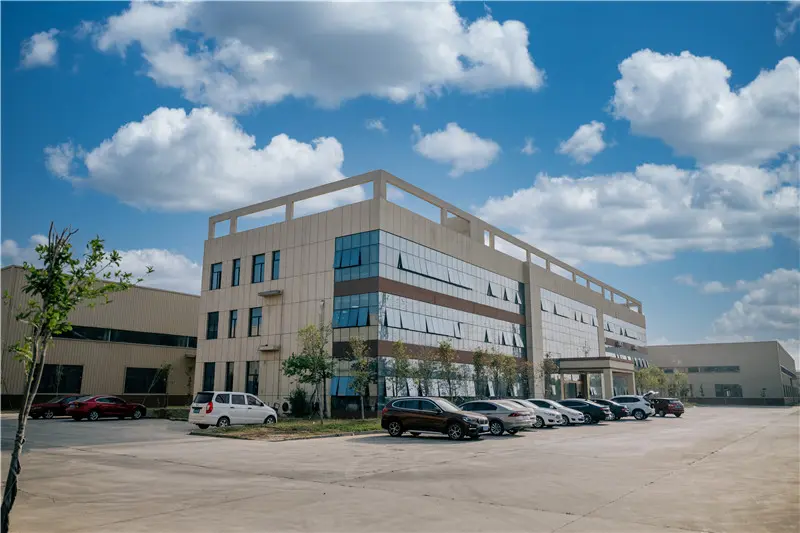
Trumony Aluminum Limited was founded in 2017 and is headquartered in Suzhou, China. It operates 100,000 m² of workshops and testing centers, employs 220 people, including 25 engineers, and reports an annual output of 600,000 units. About 40% of its output is exported to markets including the EU, USA, and India, and its products reach 56 countries and regions. Its product scope includes liquid-cooling components for power battery packs, liquid-cooling components for energy storage battery packs, liquid-cooling components for high heat flux density heat exchange, and new liquid-cooling heat exchange components.
The Liquid Cooling Plate Solution for Continuous High-Temperature Duty
Heat path: from cell to coolant
A liquid cooling plate is a metal cold plate with internal channels. Heat moves from the cell case through a thermal interface material into the plate, then into the coolant. The plate does two jobs: it spreads heat laterally to avoid hot spots, and it transfers heat to the fluid with a controlled pressure drop. The cooling system then rejects the heat at the chiller or dry cooler. Cold plate performance depends on channel geometry, flow distribution, surface flatness, and the thermal interface. A plate with a good nominal thermal resistance but poor flow distribution can still produce a wide cell-to-cell gradient.
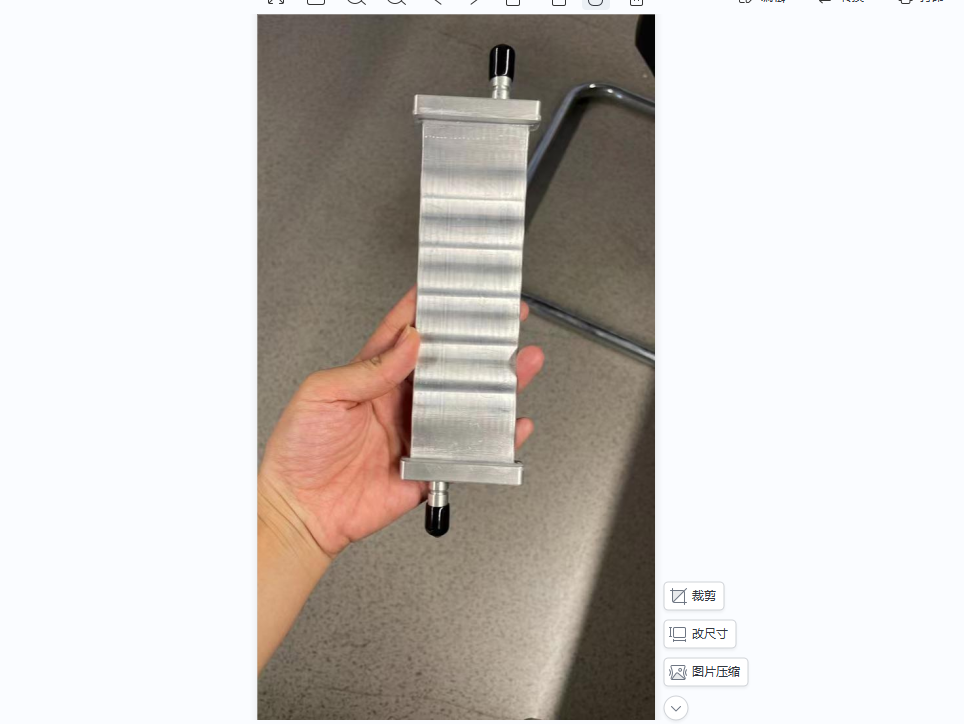
Serpentine cooling tube vs stamped and brazed cold plates
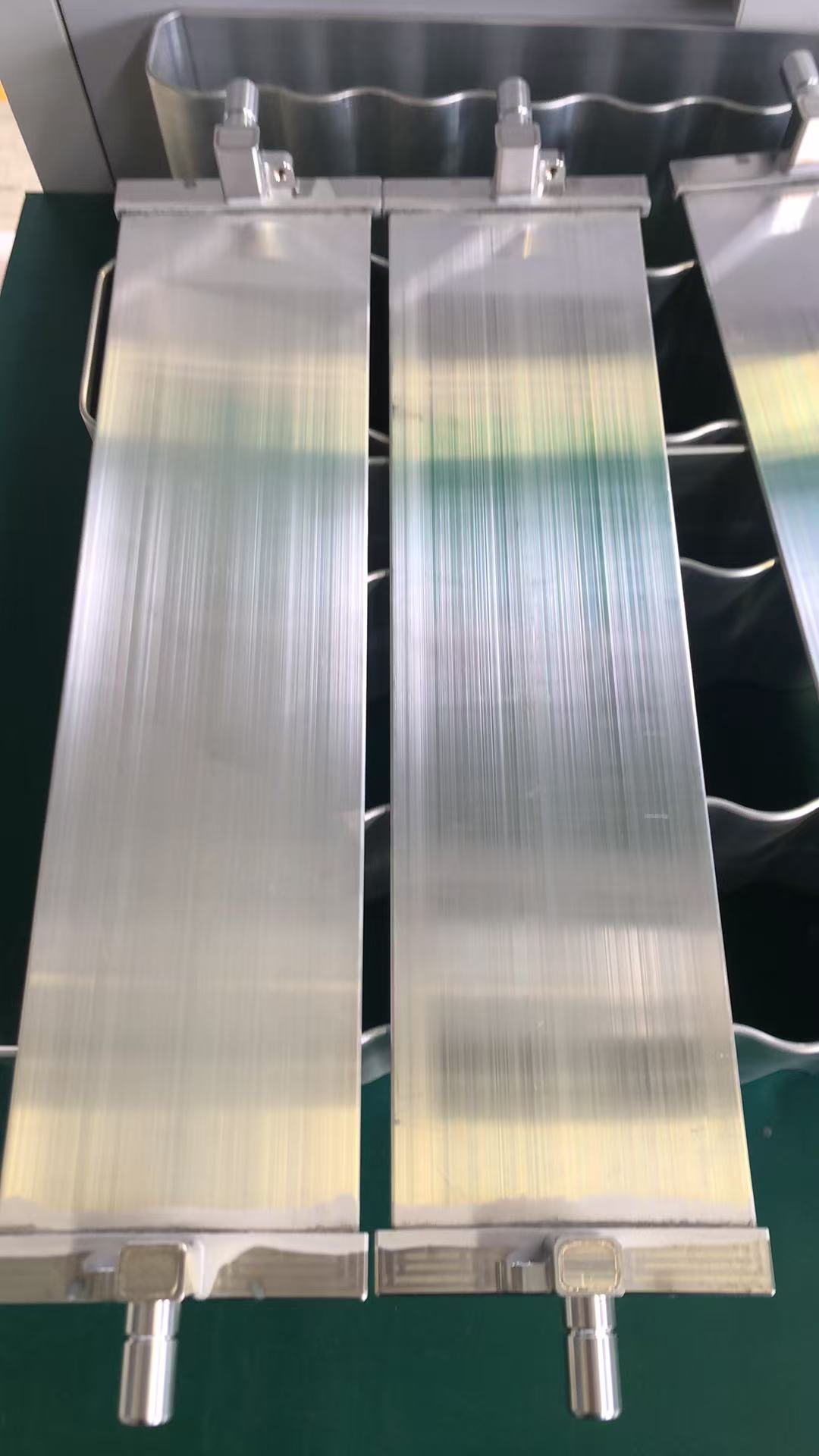
A serpentine cooling tube creates a continuous back-and-forth flow path. It is useful when the design needs a defined path across a large plate and when the tube can be bonded or brazed to the plate. The trade-off is pressure drop: a longer serpentine path increases resistance, so the pump and manifold must be sized together with the plate. A serpentine tube can also simplify the channel layout when the plate footprint is long or irregular.
Stamped cooling plates form channels in sheet aluminum and are suited to efficient mass production. Brazed cooling plates join multiple layers or a tube to a plate to create complex internal passages and a strong leak boundary. The choice is not about which process is universally better; it is about volume, channel complexity, flatness, and validation cost. A stamped plate can be cost-effective at volume, while a brazed plate can support channel geometries that are difficult to form by stamping alone.
Aluminum 3003 and customized thickness
Aluminum 3003 is an aluminum-manganese alloy used for cold plates because it combines thermal conductivity with corrosion resistance and good formability. It can be stamped, brazed, and coated. Customized thickness is a design variable: a thicker plate can improve spreading and mechanical stability, while a thinner plate reduces weight and material cost. The right thickness depends on the pack footprint, mounting compression, pressure, and flatness target. It should be fixed after the heat load and interface design are known, not chosen from a catalog as a first step.
Epoxy coating and supporting cooling system
Epoxy coating is a dielectric and corrosion-resistant layer applied to the coolant-side or external surfaces, depending on the design. In EU installations, condensation and humidity are practical concerns, especially where the coolant is below dew point. A coating helps protect the aluminum surface, but it must be compatible with the coolant and applied without blocking critical surfaces. The cooling system also needs a pump, reservoir, filter, sensors, and controls; the plate is one component in that loop. If the plate is optimized without reference to the pump curve, the assembled system can lose the thermal margin that the plate was supposed to provide.

Leak integrity, temperature sensing, and pre-shipment testing
Leakage is the highest-consequence failure mode in a liquid-cooled ESS. Trumony’s risk controls include 100% air tightness testing and helium leakage testing, supported by temperature sensors for thermal protection. Pre-shipment test procedures should be agreed before the first article is released. For a 24/7 project, the buyer should review the test method, acceptance criterion, and record format, not only the test name. A leak test that is performed on a sample is not equivalent to a 100% production test, and the purchase order should make that distinction clear.
Certifications and commercial terms
Trumony’s quality management systems have passed ISO 9001 and IATF 16949. For EU ESS projects, the buyer may also require CE and RoHS declarations. Commercial terms can be structured around a MOQ of 1 unit for validation, a typical lead time of 30 days, and FOB or CIF shipping terms. Those terms make it possible to test a single plate before committing to a project release, which is important when the cooling loop and the battery pack are still being optimized.
Step-by-Step: Specifying a Liquid Cooling Plate for a 24/7 ESS Project
- Define the continuous heat load. Start with the 24/7 duty profile: average charge and discharge power, peak power, ambient temperature profile, and solar gain. A cooling plate sized for a short peak may be undersized for continuous operation.
- Set thermal acceptance criteria. Agree on maximum cell temperature, maximum cell-to-cell spread, coolant supply temperature, and pressure drop. These criteria belong in the purchase specification, not in a separate email thread.
- Choose the flow path. Select a serpentine cooling tube, stamped channel, or brazed channel based on heat load, pressure drop, and production volume. A serpentine path can provide defined coverage; stamped and brazed plates can offer efficient production and complex passages.
- Specify material and thickness. Use Aluminum 3003 where corrosion resistance and formability are required. Set customized thickness against flatness, mounting compression, and weight targets.
- Select surface treatment. Add epoxy coating when condensation, humidity, or coolant compatibility requires a dielectric barrier. Confirm coating thickness and masking areas with the supplier.
- Design the interface. Define thermal interface material, mounting points, flatness, and compression. The best plate will underperform if the interface is uneven or the mounting pressure is uncontrolled.
- Validate leak and flow. Require 100% air tightness and helium leakage testing, plus flow and pressure verification. Review the record format and acceptance criteria before production starts.
- Integrate the cooling system. Match the plate to the pump, chiller, manifold, filter, and sensors. A plate with low pressure drop may allow a smaller pump; a high-pressure-drop design may need a larger pump and stronger manifolds.
- Release with commercial terms. Confirm MOQ 1 unit for samples, 30-day typical lead time, and FOB or CIF terms. Agree pre-shipment inspection and documentation before production.
Use Cases: Where 24/7 Liquid Cooling Plates Fit
Containerized BESS in Southern Europe
A containerized BESS providing grid services can cycle continuously through the day. In Southern Europe, high ambient temperature and solar gain reduce the temperature difference available at the dry cooler. A liquid cooling plate with a serpentine cooling tube, Aluminum 3003 construction, and epoxy coating addresses the combined thermal and humidity risk. The buyer should also require 100% air tightness and helium leakage testing, because a leak inside a container is difficult and expensive to service.
Commercial and Industrial ESS
A commercial and industrial ESS installed in a factory or logistics site may face dust, heat, and limited maintenance access. A stamped cooling plate can be an efficient choice when production volume is stable and the channel geometry is well defined. The plate should be matched to a cooling system that can be serviced without removing the entire pack. Temperature sensors and accessible test points help the operator distinguish a plate issue from a pump or chiller issue.
EV Fast Charging and High-Power Packs
EV battery cooling plates face short, high-intensity heat loads rather than continuous ESS loads, but the same plate technology applies. A brazed cold plate or a serpentine tube design can provide the channel coverage needed for high heat flux areas. The difference is in the duty profile: an EV pack may need peak rejection, while an ESS pack needs steady rejection. The supplier should be told which profile applies, because it changes the channel design and the validation plan.
Utility-Scale Storage with Limited Maintenance Access
A utility-scale storage site may be remote, and maintenance windows may be infrequent. Reliability becomes a procurement criterion alongside thermal performance. The plate should be specified with a clear leak boundary, corrosion protection, and test records that can be audited later. A sample order at MOQ 1 unit allows the buyer to validate fit and leak integrity before the full project release.
Comparison: Aluminum Liquid Cooling Plate vs Copper Tube vs CNC Cold Plate
At the decision stage, the useful comparison is not a generic “best cooling plate” ranking. It is a like-for-like comparison of construction, relative cost, production time, efficiency, and maintenance. The table below uses Trumony’s product comparison data for its aluminum cold plate against copper tube and CNC cold plate alternatives.
| Option | Best fit | Thermal efficiency | Relative cost | Production time | Maintenance |
|---|---|---|---|---|---|
| Aluminum liquid cooling plate (Aluminum 3003, stamped or brazed) | EV and BESS battery packs, including 24/7 ESS | Higher efficiency than copper tube and CNC cold plates | Baseline | Baseline; 60% faster production than CNC | Less maintenance than copper tube and CNC |
| Copper tube cold plate | EV and ESS | Lower efficiency than aluminum plate | About 30% higher than aluminum plate | Not stated in source data | More maintenance than aluminum plate |
| CNC cold plate | Battery pack thermal management | Lower efficiency than aluminum plate | About 10% higher than aluminum plate | About 60% longer than aluminum plate | About 10% more than aluminum plate |
Source: Trumony product comparison data for aluminum cold plates versus copper tube and CNC cold plates. Values are relative, not absolute.
FAQ
Do 24/7 ESS cooling plates need IATF 16949 and ISO 9001?
IATF 16949 is the automotive quality management standard, and ISO 9001 is the general quality management standard. For EU ESS projects, buyers often require both, plus CE and RoHS declarations where applicable. Trumony’s quality management systems have passed ISO 9001 and IATF 16949. A certificate alone is not enough: the buyer should also review pre-shipment test records for air tightness and helium leakage, because those records show how the leak boundary is controlled in production.
Can a liquid cooling plate be customized for high-temperature 24/7 operation?
Yes. The plate can be specified with customized thickness, Aluminum 3003 material, a serpentine cooling tube or stamped or brazed channel design, and an optional epoxy coating. The cooling system can be developed around the plate, including the pump, manifold, and sensors. The customization should start from the continuous heat load and the allowable cell temperature spread, not from a catalog size.
How does the cost of an aluminum liquid cooling plate compare with copper tube and CNC cold plates?
Trumony’s product comparison data states that its aluminum cold plate offers 30% lower cost than a copper tube cold plate and 10% lower cost than a CNC cold plate. It also states higher efficiency and less maintenance in both comparisons. These are product-level comparisons. For a 24/7 ESS project, compare landed cost including coolant loop, pump, chiller, installation, and service access, not only the plate price.
What is the MOQ, and can I test a sample before a project release?
The MOQ is 1 unit, so a single plate can be ordered for fit, flow, and leak validation before a larger release. Pre-shipment procedures include 100% air tightness testing and helium leakage testing. A sample program should define the test conditions and acceptance criteria in advance so the result can be used in the project qualification file.
What is the typical lead time and what shipping terms are available?
The typical lead time is 30 days. FOB and CIF terms are available. For a 24/7 ESS project, confirm the lead time against the installation schedule and include pre-shipment inspection in the purchase order. To discuss a sample or quote, contact Tracy at tracy@trumony.com, +86 13584862808, or WhatsApp +86 13584862808. Trumony Aluminum Limited is located at D-7, Dongchuang Science and Technology Park, No. 216 Jinfeng Road, Wuzhong District, Suzhou, Jiangsu Province, P.R. China.
Conclusion
24/7 ESS cooling is a continuous-duty problem, not a peak-load problem. The practical decision is to specify a liquid cooling plate when air cooling cannot hold the cell temperature spread, then validate the plate as part of the cooling loop. For EU projects, the specification should include Aluminum 3003, customized thickness, a channel design matched to the heat load, optional epoxy coating, 100% air tightness and helium leakage testing, and the quality management records behind IATF 16949 and ISO 9001. Trumony supplies these plates with MOQ 1 unit, a typical 30-day lead time, and FOB or CIF terms. The next step is to define the heat load and request a sample or quote.
Next step: Send the continuous heat load, ambient profile, and interface drawing to Trumony for a sample or quotation. Email tracy@trumony.com or call +86 13584862808. Website: www.trumony.com.
Have Questions or Need More Details?
Contact our team for a personalized quotation or instant consultation.
Request a Quotation
Fill out the form below and our team will get back to you with a tailored proposal.
WhatsApp Direct Chat
Prefer to chat in real-time? Message us on WhatsApp for instant assistance & quick answers.
- Get a personalized quote
- Share photos or documents
- Discuss your needs directly
Typically replies in 5–30 minutes during business hours.