
Top Cooling Plate Trends for 2026 and Beyond: EV & BESS Insights
Cooling Plate Market Trends 2026: What EV and BESS Buyers Should Watch
Cooling plates are one of the most important components in EV and BESS thermal management. As battery systems become more powerful and charging speeds increase, the demand for efficient liquid cooling plates continues to grow. For procurement teams and engineers, the market trend is not just a background topic—it directly affects supplier selection, technology choices, cost planning, and long-term supply risk. This article gives an evidence-based overview of the 2026 cooling plate market trends, the technologies gaining traction, and a practical approach to evaluating suppliers in this environment.
What Is a Cooling Plate?
A cooling plate is a flat, liquid-cooled heat exchanger used to remove heat from batteries, power electronics, and other high-heat components. In EV battery packs and BESS modules, cold plates are placed under or between cells and modules, with coolant flowing through integrated channels to carry heat away. Aluminum is the most commonly used material for these components because it combines good thermal conductivity with a relatively low weight. Aluminum 3003 alloy is a standard choice for cooling plates in EV and ESS applications.
Cooling plates are also referred to as liquid cooling plates, cold plates, water cooling plates, or battery cooling plates depending on the application and manufacturer terminology. They are used in electric vehicle cooling plate systems, energy storage system cooling plate assemblies, power storage units, and powertrain thermal management setups.
Why Cooling Plate Market Trends Matter for Buyers
Tracking the cooling plate market helps buyers answer several practical questions. First, it helps with technology planning: understanding whether stamped or brazed cooling plates are gaining share, and which approach fits a given program. Second, it helps with supplier evaluation: market signals can reveal which suppliers have scale, technical depth, and the ability to support long-term automotive or energy storage programs. Third, it helps with risk management: relying on a single technology or supplier location can create vulnerabilities.
For buyers in the Evaluation stage, the goal is to turn market trends into a clear set of selection criteria before requesting quotes or samples.
Market Growth and Demand Drivers
Several verified market figures illustrate the scale of growth in this space.
- The global EV battery cooling plate market was valued at USD 3.01 billion in 2024 and is projected to reach USD 16.13 billion by 2035. This points to sustained long-term demand for battery cooling plate technology across electric vehicle programs.
- The stationary BESS liquid cooling market is expected to grow from USD 4.23 billion in 2024 to USD 24.51 billion by 2033, at a CAGR of 21.55%. Energy storage represents one of the fastest-growing segments for liquid cooling plates.
- Aluminum-based cooling plates account for approximately 64% of all cooling plate installations, reflecting the material's thermal and cost advantages.
- The Direct-to-Chip liquid cooling market was valued at USD 1.9 billion in 2024, with North America holding a 39.0% revenue share. This shows that liquid cooling expertise extends beyond EV and BESS into high-heat-flux electronics.
While different research providers use different scopes and dates, the overall direction is consistent: liquid cooling demand is rising across EV, BESS, and high-performance electronics. Buyers should use these figures as directional context rather than as precise procurement targets.
Technology Trends to Watch
Aluminum Stamped Cooling Plates
Stamped cooling plates are formed from aluminum sheets using stamping dies. They are designed for volume production and are widely considered for EV and BESS programs where component cost and consistency matter. Stamped plates are also called stamping cooling plates or stamped liquid cooling plates.
For procurement teams, stamped cooling plates can offer an attractive balance of performance, weight, and unit cost when volumes are high enough. However, the channel geometry, sealing method, and joining process must be validated for the specific coolant and operating conditions.
Brazing Cooling Plates
Brazing cooling plates are assembled from multiple aluminum layers and joined in a controlled furnace brazing process. This approach allows more complex internal flow channels and is often used when higher cooling performance or more precise flow distribution is required. Brazing is also a common process for aluminum liquid cooling plates used in EV and ESS applications.
The choice between stamped and brazed construction depends on the program's performance targets, volume, cost envelope, and supplier capability. In practice, many suppliers support both manufacturing routes and recommend a solution based on the application.
Thin and Large-Format Plates
As battery packs become more energy-dense, cooling plates must fit into thinner gaps while covering larger module or pack areas. This creates demand for battery module cold plates and battery pack cooling plates with customized thickness and cooling efficiency. A common example is a plate measuring 1298 x 616 x 7.7 mm, which spans a large module footprint while maintaining a slim profile.
Cooling Plate Applications in EV and BESS
Cooling plates serve different roles depending on the system:
- EV battery cooling plates maintain cell and module temperature within a safe range during fast charging and high-power discharge.
- BESS cooling plates help manage heat in containerized energy storage systems, where hundreds of modules operate for long durations.
- Liquid cooling plates for energy storage are becoming more common as BESS power density and cycle times increase.
- Cooling plates also support powertrain electronics, charging infrastructure, and other high-heat-flux components.
Supplier Landscape and Competitive Context
The liquid cooling plate market includes a mix of global thermal management specialists, automotive Tier-1 suppliers, and specialized aluminum manufacturers. Published market analysis names Boyd, Laird Thermal Systems, Miba, Valeo, and Modine Manufacturing among the key global players in liquid cooling and BESS thermal management.
At the same time, specialized Chinese manufacturers have developed significant production capacity and are increasingly present in international EV and ESS supply chains. When comparing global suppliers, buyers often evaluate technology depth, manufacturing capacity, certification, experience with local programs, and responsiveness.
For international buyers, Chinese suppliers can offer cost-effective aluminum cooling plate production, large manufacturing capacity, and the ability to handle custom requirements. The trade-offs usually involve longer logistics chains, communication factors, and the need to verify quality systems and certifications directly.
How to Evaluate a Cooling Plate Supplier in 2026
Supplier evaluation should combine technology capability, manufacturing evidence, certification, and real-world references. The following checklist is designed for EV and BESS procurement teams.
Technical and Manufacturing Capability
- Does the supplier offer both stamped and brazed cooling plate options?
- Can the supplier customize dimensions, thickness, cooling efficiency, and logo?
- What is the monthly production capacity, and does it match the program's expected volume?
- Does the supplier perform 100% testing on critical quality parameters?
- What is the lead time for prototypes and serial production?
Quality Systems and Standards
- Is the supplier certified to IATF 16949 for automotive components?
- Does the supplier hold ISO 9001 for quality management?
- Are these certifications valid and supported by verifiable certificate numbers?
- Does the supplier follow international standards relevant to EV and BESS thermal components?
Evidence and References
- Has the supplier delivered cooling plates for automotive OEMs?
- Does the supplier have experience with BESS pack OEMs?
- Can the supplier document stable operation in real projects?
- Are case studies specific enough to support confident supplier shortlisting?
Supplier Comparison Framework
| Evaluation Dimension | What to Check | Why It Matters |
|---|---|---|
| Manufacturing route | Stamped vs. brazed capability | Determines cost, performance, and design flexibility |
| Certification | IATF 16949, ISO 9001 | Indicates maturity for automotive and industrial programs |
| Testing | 100% air leakage test, optional helium and pressure tests | Reduces field failure risk in battery systems |
| Capacity | Monthly output and factory scale | Affects supply security during ramp-up |
| Customization | Dimension, cooling efficiency, logo | Matches plate design to module and pack architecture |
| Lead time | Prototype and production timing | Impacts program planning and launch deadlines |
| References | Automotive OEM and BESS OEM cases | Provides evidence of real-world performance |
Trumony as a Case Example in the Cooling Plate Market
Trumony Aluminum Limited is a thermal management manufacturer founded in 2017, headquartered in Suzhou, China. The company specializes in cooling components such as cold plates and cooling tubes, with an annual output of 600,000 units and a factory area of 100,000 m². Trumony's products are exported to Europe, America, the Middle East, Southeast Asia, and Russia, and the company reports serving customers in 56 countries.
For buyers evaluating suppliers, Trumony is an example of how a specialized manufacturer supports EV and BESS programs. Its product line includes EV cooling plates, BESS cooling plates, stamped cooling plates, brazing cooling plates, battery module cold plates, and serpentine cooling tubes, all made from Aluminum 3003 with customized cooling efficiency and thickness.
Production and Quality Systems
Trumony operates 100,000 square meters of standard workshops and testing centers. The company has passed ISO 9001 and IATF 16949 quality management systems. The ISO 9001 certification was issued on 2023-09-21 with certificate number 132998 and is valid until 2026-09-21. The IATF 16949 certification was issued on 2023-11-27 with certificate number 0489498 and is valid until 2026-11-26.
From a buyer's perspective, these certifications mean that Trumony has established quality processes suitable for automotive-grade thermal components, and that its quality system is under regular external audit.
Manufacturing Capability and Testing
Trumony offers OEM production with a monthly capacity of 500,000 units and a lead time of around 30 days. The minimum order quantity is 1 unit, which is relevant for prototyping and validation before mass production. Customization options include dimension, cooling efficiency, and logo.
Quality control includes a 100% air leakage test and dimension test. Optional tests include helium tightness test, voltage resistance test, hydrostatic strength test, burst test, high temperature resistance test, and low temperature resistance test. This testing scope helps buyers select verification levels appropriate to their application risk profile.
Customer Evidence
Trumony provides three verified reference cases:
- An automotive OEM client in Germany used 2000 units of cooling plates for a paint shop application, with 2 years of stable operation and low noise.
- An automotive OEM client in Vietnam used 60,000 units for battery pack cooling, with stable operation, low cost, high quality, and low noise.
- An ESS PACK OEM client in China used 3000 units for ESS container applications, with 15 years of stable operation, low noise, low cost, and fast lead time.
For a buyer, these cases show that the company has experience across automotive and energy storage applications, and across different regional supply chains.
FAQ
Which cooling plate is better for EV and BESS: stamped or brazed?
The choice depends on the program. Stamped cooling plates are generally suited for high-volume production and cost-sensitive applications, while brazing cooling plates can support more complex internal channel designs and higher performance requirements. Many suppliers, including Trumony, offer both stamped and brazed options in Aluminum 3003 and recommend a structure based on cooling efficiency, operating pressure, and cost targets.
What certifications should a cooling plate supplier hold for EV and BESS programs?
For automotive EV programs, IATF 16949 is a widely recognized quality management certification. ISO 9001 is the general international quality management baseline. Depending on the destination market and application, CE and RoHS compliance may also be required. Buyers should verify the certificate number, issuing authority, and validity period directly with the supplier.
Can cooling plates be customized for a specific battery module design?
Yes. Cooling plates can be customized in dimensions, thickness, cooling efficiency, and even logo marking. For example, Trumony offers OEM cold plate and cooling tube production with a monthly capacity of 500,000 units and an MOQ of 1 unit for prototyping. Customization typically requires a drawing or technical specification of the module layout and thermal requirements.
What is the typical lead time for cooling plate orders from Chinese suppliers?
Typical lead time depends on whether the product is a prototype or serial production. Trumony lists a lead time of around 30 days for OEM cooling plate production with a monthly capacity of 500,000 units. Buyers should confirm the lead time for their specific configuration, coating, and packaging requirements before placing an order.
How do I request a sample or quote for a cooling plate project?
To get started, send your technical drawing or target specifications—including module size, thickness, flow rate, pressure drop, and coolant type—to the supplier's engineering team. For Trumony, you can contact Tracy at tracy@trumony.com or via WhatsApp at +86 13584862808. A typical first step is a drawing review and a quotation based on the required volume and testing level.
Conclusion
The 2026 cooling plate market is defined by sustained growth across EV and BESS applications, material preference for aluminum, and a supplier landscape that spans global players and specialized Chinese manufacturers. For buyers, the priority is not simply to find a supplier, but to find a supplier whose manufacturing capability, quality systems, and references align with the specific program requirements.
Use the evaluation framework in this article to compare suppliers on technology, certification, testing, capacity, customization, and evidence. If you are in the evaluation stage, the most practical next step is to send a drawing or specification to a shortlisted supplier and assess the response quality, lead time, and willingness to support prototyping.
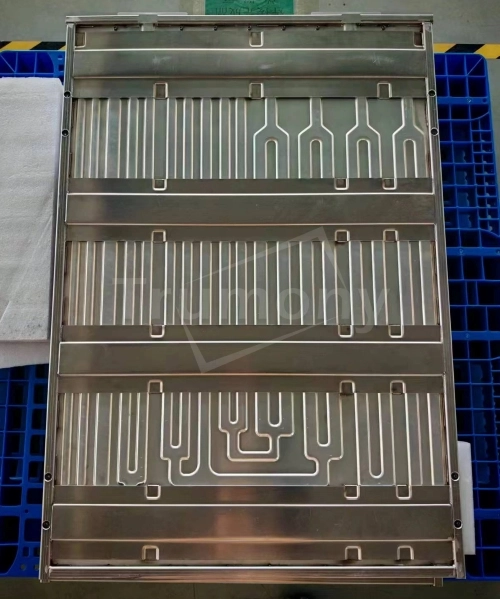
Image: Cooling plate components for EV and BESS thermal management.
Get a Cooling Plate Evaluation for Your Application
Trumony welcomes drawing reviews from EV and BESS OEMs. Contact Tracy at tracy@trumony.com or +86 13584862808 to discuss your cooling plate requirements.
Appendix: Content Units and Source References
This article was generated from verified content units including the company background of Trumony Aluminum Limited, certification records for ISO 9001 and IATF 16949, OEM capability data for cold plates, and customer case references from Germany, Vietnam, and China. Market figures are sourced from Market Research Future, Business Wire, Market Growth Reports, and Grand View Research, with citation links available in the verified data section.
Visit Trumony Aluminum Limited
Have Questions or Need More Details?
Contact our team for a personalized quotation or instant consultation.
Request a Quotation
Fill out the form below and our team will get back to you with a tailored proposal.
WhatsApp Direct Chat
Prefer to chat in real-time? Message us on WhatsApp for instant assistance & quick answers.
- Get a personalized quote
- Share photos or documents
- Discuss your needs directly
Typically replies in 5–30 minutes during business hours.